Sunday, December 22, 2013

A Free Market in Law Benefits The 99%

I hear an awful lot of socially conscious liberals bemoan the wealth/income disparity. They rightly point out the social injustice present in this disparity. The ultra-wealthy retain for themselves special benefits that the rest of us cannot afford. They "suffer" from affluenza, and live by a different set of rules.

How does the wealth disparity arise?


First, let's acknowledge that while we each may want more wealth, we do not have a guaranteed right of possession. For example, if everyone on Earth were given the same amount of wealth, knowledge, and opportunity at the beginning of a day, they would each have different levels of that wealth at the end of the day. This results in accordance with each individual's different values on how to best spend that wealth. So a disparity in wealth arises as a natural consequence of differences between individuals.


But that same disparity can grow, quite unnaturally, through political means. When society organizes itself to permit a special class of people that follow different rules of conduct, the wealthy grow to inhabit that position. They purchase favor from lawmakers and enforcers, pricing such intervention out of the reach of the masses. What starts off as unequal treatment in the eyes of the Law, results in lawmakers that twist it to enforce the inequality of means and restrict the opportunities available to the masses.

Once the rich have spent some wealth on maintaining their high standard of living, they spend their remaining funds on political manipulation, which can take the form of donations to specific charities or media produced by agenda-pushing think tanks. I don't begrudge the rich this opportunity to try and change the social fabric, as long as they pay the costs of that activity.

Why do we tolerate the disparity?


I do take issue when the rich partner with the political class and push for social change through government intervention. Using the mechanism of campaign contributions, the rich effectively steal my money. They divert my taxes into their pockets, via subsidies for protected industries, special exemption in the eyes of law, and production of propaganda that promotes their social agenda.


For example, under the politically popular support for green and sustainable energy technology, the politically connected corporation Solyndra received and scuttled the wealth of taxpayers, giving them nothing but scandal in return.
Solyndra received a $535 million U.S. Energy Department loan guarantee before going bankrupt. Under the Solyndra restructuring plan, the government is projected to recoup 19 percent on $142.8 million of the loan and nothing on the remaining $385 million.[19] Additionally, Solyndra received a $25.1 million tax break from California's Alternative Energy and Advanced Transportation Financing Authority.[20]
The majority of Solyndra funding was provided by the American Recovery and Reinvestment Act. 
Wikipedia
Though examples of political graft take place in all governments at all levels from local to national, no individual case has yet provoked the ire of the masses to abandon hope of reform and change. The public still clings to the idea that lawmakers can respond to their desires. We find ourselves distracted with promises of bread and circuses, of transparent bureaucracy, of politician accountability. On these empty promises we still hope for change.

What should we do to rectify the disparity?


Recall, that I started this article about wealth, showing how it leads to social manipulation that protects the wealthy class. We do not solve this problem by forming an organized Robin Hood force that robs the wealthy and redistributes to the poor. An agency capable of that feat already exists, and it remains under the control of the very wealthy being targeted.

Government cannot be the answer, because government exacerbates the problem. It enables the politically favored to become wealthy. It enables the wealthy to practice political protectionism. No! We must take away that tool that the wealthy have used to obtain their special status! We must dismantle the iron fist that protects them.

We can lessen the wealth disparity by privatizing law. By wresting law from the manipulation of government and putting in into the hands of individuals who need its services. We need for the law to treat everyone equally.


A Private Market of Law


The production of law requires fewer initial capital expenditures than machinery and electronics. It involves less complexity than computer operating systems and applications. It retains a similarly high cost in education and training compared to technological services. If people produce computers, cars, and most everything else using a system of private investment, why not also law?

Should we convert to a system of private arbitration, I would expect that dispute rulings become more fair in the eyes of the masses, and more accessible.

Consider that arbitrators will persist in competition with each other. We cannot expect that an arbitrator who begins systematically favoring the rich clients at the expense of the poor ones to remain in business. I conceded that the rich clients might use that arbitrator's services with each other, but they would be unable to find willing business partners among the lower economic rungs. By insisting on the use of such an arbitrator, they lose out on valuable business with the masses.

We can also expect that the vast majority of cases arbitrated will occur between people of lower economic status, simply because more of them exist, and they have more interaction with each other. Consequently, for most arbitrators, their majority of clients will be from the lower economic strata, whether directly or through legal insurance agencies, so they will have to take care to make rulings fair to these clients.

The economics of law on a free market on a free market, strongly encourages paying attention to the 99%. because they form the majority customer base. The arbitrator gets squeezed in the provision of law, for they must pronounce rulings fair in the eyes of a majority of clients. While clients get squeezed in their selection of law, for they must choose arbitrators that all parties can agree upon.

The process of the free market produces a law that represents the interests of those who elect to use it. In contrast, our current system produces law via a corrupt political process. The competition driving a free market of law treats the rich person as equally as it treats the poor. Neither one can use the difference in social status as leverage against the other.

Article about the book in The Freeman
Review at Center for a Stateless Society
Society can prosper by producing law outside of government. Within a free market of law, the rich no longer have the ability to practice regulatory capture, drafting laws that favor themselves at the expense of the masses. They no longer have the means to delegate special privileges to themselves. They no longer retain special social status and the resulting benefits. The market will make them pay for their injustices as it does all criminals.

If you don't yet believe in the practicality of a Free Market in Law, please consider the cases that David D. Friedman discusses in Ch 29. Police, Courts, and Laws -- on the Market, of his book Machinery of Freedom, or the chapter about Anarchy and Efficient Law from John Sanders and Jan Narveson's book For and Against the State.

Finally, it doesn't matter that you may not believe my argument. Private arbitrators currently hear more than 80% of disputes within the United States, and their rulings did not admit government guns for enforcement until recently. The Admiral himself benefits from the international market for law, which already covers 20% of WORLD GDP, resulting from international commerce. What government could make a rightful claim to use only its legal monopoly in such disputes?

Update [140105]. The 20% figure comes from the end of Peter Leeson's talk on Anarcho-Capitalism. I think that the 80% figure comes from David D. Friedman's Machinery of Freedom, but in any case it's dated, but I don't expect that it has changed significantly. Check the American Arbitration Association for more recent stats. Also read those wordy papers you signed at the dentist, doctor office, bank checking account, etc. Many of them contain an arbitration clause.

Monday, December 2, 2013

Arguing Against Inflationary Currency by Famous Example


During the last Liberty on The Rocks meeting about Bitcoin, I found myself in an argument with a fellow that claimed that a deflationary currency would harm the economy, because it discourages spending. I quickly countered this opinion by stating that I believed the opposite: that without an encouragement of savings, the economy would collapse.


Alas, he could not say why we would want to privilege spending over saving, other than to state that without spending we wouldn't have exchange. So I pointed out that spending occurs regardless: I need food, water, housing, fuel for my car, clothing, etc. No matter how the underlying currency fluctuates relative to these goods and services, I and everyone else will continue spending. The only effect that promoting discretionary spending over savings has is to promote some industries (such as entertainment) over others. Why does the economy need artificial, and preferential encouragement of these more consumerist industries?


Still, in the face of these questions, my partner in argument had not yet changed his opinion, so I tried a different approach, arguing by analogy.

Suppose that there existed an industry where consumers expected a substantially better product each year, and at a lower price! Would you, as a producer, ever choose to enter this industry, or would you instead decide on something more mundane and stable? A different industry, where you wouldn't have to work as hard at improving product and where sales kept a high price. If customers can expect to purchase a better product at a cheaper price every 6 months or so, then why would they buy today? Surely even sales in this industry would experience low volume. From looking at both sides, and in keeping with your argument about a deflationary currency, would you then predict that this industry remains quite small compared to others, because of the continuously devaluing wares?

Well, devious debater that I am, I just described the electronics/computer industry which has experienced explosive growth unlike any other, in every year since 1960! One of my favorite examples, specifically for knocking down the "we won't have spending without inflation" argument. As if the compulsive, grasshopper consumers need an additional, abstract reason not to save for the future.


Far from discouraging spending, the continuously increased quality has instead generated recurring sales. Rather than saving their ever more valuable dollar, the consumers in this market exhibit strong time preference: they don't want to wait a newer, better, fancier product 6 months hence. They want the latest and greatest RIGHT NOW! Every year a saved dollar can buy more processing power, more memory, lower power consumption, smaller device size, etc. But that incentive for saving hasn't halted the spending. Instead, the rapid pace of change drives sales: once their existing wares become obsolete (which happens quickly) consumers go out and purchase anew.


Unfortunately, I was unable to penetrate the Keynesian mythology that fogged his mind, and my colleague remained unconvinced by what I consider a remarkably compelling example.

Saturday, November 23, 2013

Liberty on the Rocks: Bitcoins not Bombs

After a day of slaving my labor for The Man, I found myself with a refreshing drink of dark lager at the Bootlegger's Brewery. My favorite drinking club, Liberty on the Rocks, was hosting a Bitcoins not Bombs event. In spite of cooler weather, and a threat of rain, which remained fortunately unfulfilled, we amassed a numerous and eclectic crowd of folk. Plenty of newer faces showed up, at least 30 in all, each one eager to discuss the merits of bitcoin as a currency. Plenty of speculation about the future of bitcoin, including it's world-wide suitability, rate of adoption, and (of course) future price.

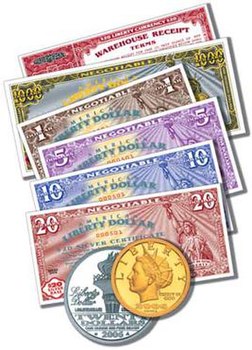
The event even attracted the attention of the CEO of newlibertydollar.com, Joseph VaughnPerling, who was kind enough to donate one of his new QR-encoded bitcoin silvers to the raffle. LoTR also gave away 3 other envelopes of bitcoin, each valued at about 10 U.S. Fed Reserve Notes (and rapidly appreciating in value), in an effort to promote awareness and use.

Bootlegger's serves only beverages and carries no food, so our group was greatly disappointed that the food truck cancelled their appearance. But, being so heavily anarchist, there were some among us who knew how to deal with a failure in planninng. They had kind generosity to order pizza. Joseph donated a couple pizzas, and pointed out his self-interest in the matter: "Hungry people are grumpy. I don't like talking to grumpy people." I'm sure our other benefactors felt similarly and took action not exclusively motivated by altruism.

During mingling, many things were discussed. We noticed a correlation between the excitement an individual had toward bitcoin and any resultant payoff. VaughnPerling discussed the case of Bernard von NotHaus, who had plenty of his wealth confiscated but is yet to be locked in a cage by the government for circulating coins which they considered similar enough to be threatening as counterfeit. (Exactly how gullible do these government judges think we are?)

Much of the conversations during the mingling I didn't catch. I received some good information from a suited fellow advertising his gun-training and shooting services (email me for more info), talked at length about why government sucks which everyone there already knew, and I tried to convince anyone who'd listen that anarchy would be better (that will be discussed in a secondary post).

So successful was our event, that a new Facebook group formed: The SoCal Bitcoin Syndicate #WeLiveFreeBTC.

Any and all are welcome to attend the next LoTR meetup: A celebration of Saturnalia at 7:00pm on Dec 5th at The Stave in Long Beach. Both #LiveFreeOC and #LiveFreeLA will attend!

Saturday, November 16, 2013

Renting on the Black Market

Today, I'm complaining about an inconvenience caused by government. My landlady and I have a nice arrangement, I pay her for the roof over my head and a place to store my stuff. In my opinion, our business relationship requires no third parties. But the local politicians think otherwise.

My landlady, long ago, extended her house to include an upstairs. A living room rests over the garage and behind it two bedrooms and a bathroom sit above the living room and kitchen of the ground floor. I'm renting out one of the bedrooms and another tenant rents the other. The construction of an exterior stairway, placed alongside the garage allows for us to come and go through a side-gate without interrupting my landlady. Since I am still young enough to spend the occasional late night of anarchic drinking in town, I find this arrangement mutually beneficial, as my fashionably extra-late return home does not have to wake her.

Just last week she told me that she has decided to refinance her mortgage. Consequently, the bank will be sending an inspector. Under ordinary circumstances, I might not care, but this inspection complicates the relationship that I have with my landlady. Her son, who acts as a handyman, will stop by this weekend to take the stove out of the upstairs kitchenette that I share with the other tenant. He will also remove the partition that currently covers the indoor stairway between the two floors, lowering our mutual privacy.

Now why should he take away the stove and stairway cover? I did not sign on an a tenant to be so rudely interrupted. When I queried about the unnecessary disruption, I found out that she, in her sweet, elderly way, acts in a dark and shadowy market, subverting government and its accessory taxation. She rents out part of her home <cue revealing music> without a license!


Apparently, the city has declared a house with two stoves illegal. That body politic also declared the renting out of a room, activity requiring a license. I bet some hotel cartel or renters association put them up to it. Or perhaps they just think that they are keeping me "safe from exploitation". The government officiates probably think that my 80-plus yr old landlady, menacingly threatens society as she ambles around in her walker, wringing her hands over of all the rent money I voluntarily agreed to pay. Because if they ever found out she operates without a license, or that her house has a fire-hazard second stove in the upstairs kitchen, all manner of fines and levies would surely find their way into her mailbox.

Just who do these government thugs think they are? What right do they possess? They threaten an old lady, who's just trying to scrounge up some extra funds by renting out space she's no longer able to use, and expect me to thank them? I hate those guys.


Sunday, November 3, 2013

Arguments found on Facebook, Government License.

I have a friend on Facebook (who shall remain anonymous) that occasionally posts articles which cast some topics that I have a fondness for in a negative light. In this case it was an article about How Ayn Rand ruined my childhood. I happen to sympathize with the authors opinion, for her father sounds like an ideological jerk who could might benefit from learning how to empathize with others. But I don't extend the blame all the way to Rand's philosophy of objectivism. The role of that philosophy as an enabler for poor behavior certainly forms an argument against its use as justification. But then, so do the crusades and inquisition form an argument about how the christian belief can be used to justify violence. These uses call into question the acceptability of these beliefs as part the fabric of social interaction, but should not be confused with the logical framework of religion or objectivism as a belief system. For that task, we need logical arguments that point out internal inconsistency in doctrine, not mere associations with the poor behavior of the followers.

Well, already I've said more about the article than I meant to. Let me refocus on the ensuing Facebook conversation which motivates this post.

As you may predict, I all too often take my friends bait. He posts an article critical of my political ideology, and I rise to defend it. His friends (many of them believers in democracy) also feel a need to be heard, or to hurl insults at my selfish, asinine, childlike, undeveloped, un-workable viewpoint. I might add that the insults are much to my amusement, and those who hurl them can be readily disarmed with simple questions:
I sense strong emotional hostility against libertarianism. Can you explain what you feel about libertarians? The insults you've hurled might be motivated by fear. Do libertarians threaten you?
In this case, I was met with yet more insults rather than answers, and that particular person got deleted from the thread. On the one hand, I'm consistently left with amazement at the level of hostility, and on the other I lament that these folk don't take the time to understand the Non-Aggression Principle,  for I would expect that we might have a common ground in our desires to have a society that abstains from institutionalizing theft, violence, or coercion.

Of course, I'm motivated to partake in these discussion, not just because I want to defend my position, but primarily because I find great amusement and entertainment in the arguments themselves. Those that believe in government (or the necessity of government) make some rather odd arguments:
It's so funny how that NAP of your never quite makes it to how you injure people indirectly with economics. Despite the fact that there is no inalienable right to business and since it is a LICENSED privilege, the Government is well within its right to regulate your business and your private slice of the economy any way they see fit. The economy belongs to EVERYONE, not just you. Despite how much more you may have than anyone else.
A similar viewpoint was made by Rousseau in The Social[ist] Contract regarding denial of the right to suicide and the state's claim to conscription:
Furthermore, the citizen is no longer the judge of the dangers to which the law-desires him to expose himself; and when the prince says to him: "It is expedient for the State that you should die," he ought to die, because it is only on that condition that he has been living in security up to the present, and because his life is no longer a mere bounty of nature, but a gift made conditionally by the State.

It remains completely obvious to me that if I own my life then I alone have the right to take it. Obvious to Rousseau, too, for he takes great pain to assemble an argument that I do not have exclusive rights over my person, the state has a partial claim. Rather than detail his argument here, I'll handily dismiss it by pointing out that, though my life as I currently lead it depends on interaction with others (the economy, friends, family), I do not owe any of that to a government.

History and logic adequately demonstrate that humans and society existed before government, so it is certainly not government to which I owe my well-being. To believe the state's claim over my person because my labor is needed to fight in the war to end all wars, would be to believe a slave-master's claim of ownership over the slave because "somebody's gotta pick the cotton!"

The slave-master and government share another similarity in their means. In order for the master to direct the labor of the slaves he necessarily meets non-cooperation with violence in the form of lashings and hot-boxes. The government also meets non-cooperation of its citizen through violence. If I don't pay my taxes, then I will be given an extended time-out in jail. Nevermind that I didn't hurt anyone by neglecting to file, I'll certainly be raped in prison.

Now, let's get back to the economic misunderstanding in the quote from debate opponent on Facebook.

It's so funny how that NAP of your never quite makes it to how you injure people indirectly with economics.
I'm really not sure, based on the definitions, how the Non-Aggression Principle could possibly cause economic injury, directly or indirectly. If any particular act did cause injury, then it would be classified as a form of violence. The initiator of such violence is guilty of aggression, and therefore in violation of the NAP. Clearly, we have some misunderstanding of terms, but that's typical in any debate.
Despite the fact that there is no inalienable right to business and since it is a LICENSED privilege, the Government is well within its right to regulate your business and your private slice of the economy any way they see fit.
Well, technically, I can't claim the right to business is inalienable, because Government has demonstrated its ability to interfere, prevent, squash, regulate, and even license business. All actions that indeed infringe on my right to do business. But, I do strongly object to the claim that business only exists as a result of government license. Everyone has traded items in the schoolyard with friends. It may only be a small barter exchange, but it happened without government approval. That's unlicensed business!


To claim that the transactions, which form the foundation of business everywhere, only happen under government license is sheer folly. It's an empty claim that flies in the face of voluntary transactions everywhere. I see no reason to believe that the wide-spread practice of people voluntarily entering into transactions with each other, exchanging goods and services, would stop if government neglected its role of issuing licenses. Indeed even authors of fiction recognize this fact. In all the post-apocalyptic fiction I've encountered, people still conducted business. They did so before government began issuing license and continue to do so when government collapses.
The economy belongs to EVERYONE, not just you. Despite how much more you may have than anyone else.
One folly in logic births another. Again, I'm met with a clear misunderstanding of the economy and property rights. Even if I accepted the false premise that the economy belonged to everyone, that isn't enough to argue that the government is the only institution qualified to issue rights of participation (a.k.a. licenses) in the economy. What right has government to claim this monopoly on the economy? Do I have to point out that there exists a global economy wholly unregulated by any one government? International trade is responsible for 1/4th of World GDP and yet no government claims ownership over that economy.

Rather than belonging to everyone, the economy doesn't belong to anyone! It's the aggregate result of individual transactions, an emergent property of social interaction. The amount of stuff I have, and my access to credit, determine the transactions I'm able to participate in. Even the largest player in the market (up to 73 billion in a lifetime) are dwarfed by the economy as a whole (up to 70 trillion dollars exchanged per year). Everyone can certainly participate in the economy as a player, but nobody and no institution singularly determines the game.

Monday, September 9, 2013

Liberty Brunch at the Matador


It seems that all my recent posts have been about drinking and anarchy. Oh what a libertine soul I have! When the chance came up for imbibing for brunch, how could I restrain myself? No! Statism is for lazy chumps, while talk of anarchy is for the mentally active!

I showed up on time (10am) which was never a problem for evening gatherings, but proved to be 20 minutes early for this one. It seems the anarchists in my battalion lack discipline in their drinking. Nevertheless, I must concede that brunch is now my favorite of such gatherings, because it features a less crowded environment affording us more attention from the staff and only our own raucous conversation for background interference.


The Matador Cantina graciously served us brunch and booze, and even gave us all the tables in the back room. But that only makes responsible business sense, as we were the largest party in the establishment and required two tables. Unfortunately, the breakup of the party into two subgroups means that I cannot report on all the conversational topics.

A reasonable amount of discussion followed a recurring theme: The pursuit of happiness. We talked of love, relationships, group dynamics, evolution of sexual behaviors, the rough mating rituals of Ayn Rand's characters, and many other various pleasures of life.

Our fellows coming back from Libertopia regaled us with musings of some events and escapades. I really missed out, because they were twice able to breakfast in the esteemed company of the fabulous Jeffery Tucker. Fortunately, I can live vicariously through their tale, because they b(r)ought for me a lovely paisley 100% silk bowtie previously worn by the fashionable author of Burbon for Breakfast. And who said that anarchists don't have a sense of community? I flaunt my new bowtie at you!


I shall never cease to be encouraged by the average self-education level of libertarian groups. In one sense, we strongly self-select. In order to become libertarian one must live in a land of statism and somehow survive the indoctrination camps disconcertingly referred to as "schools of education." It seems that we have all managed to endure this mental handicap and found an inclination to use freely available resources (thar interwebs) to give ourselves knowledge formerly denied us. Each time these meetings have a wonderful sharing of knowledge and wisdom.

Consequently, I've never been to a meeting at without at least one book recommendation. This time I have several.
  1. Order Without Law by Robert Ellickson
  2. The Beautiful Tree by James Tooley
  3. Selfish Reasons to Have More Kids: Why Being a Great Parent is Less Word and More Fun Than You Think by Bryan Caplan.
  4. Sex at Dawn: How We Mate, Why We Stray, and What it Means for Modern Relationships by Christopher Ryan by Cacilda Jetha
  5. A Renegade History of the United States by Thaddeus Russell
  6. Why We Get Fat: And What to Do About It by Gary Taubes
  7. Salt by Mark Kurlansky
  8. The Beautiful Tree by James Tooley
A civil engineer join our ranks, so I even got to learn who will build the roads! Even more fascinating he told me that raw material industries such as lumber and steel self-organize to form standards of construction. These documents make it easier for construction companies to adopt those materials for building houses and other structures. To mention a specific example: the lumber industries doesn't want wooden houses to collapse, because then people might stop using lumber for that purpose. So they helpfully provide standards of construction.

The state regulation board then takes these standards (already independently created by industry) and then gives it's magical blessing of bureaucratic authority. Clearly government regulation doesn't save us from the "evils" of these corporations. Even more to the point: good regulations require specialized knowledge. Often that knowledge comes directly from the industry being regulated. Individuals within the lumber industry knows how many trees can be cleared out of a forest without permanently damaging its ability to regrow. Government bureaucrats don't, so they rely on industry to inform them.


So I've found that where regulation is necessary and proper, industry has incentives to provide for itself. Government only adds a burden to those pre-existing market mechanisms. Government regulation: IT'S A TAX!

#LiveFreeOC and keep on keeping on.

Tuesday, August 20, 2013

Liberty on The Rocks, Orange County #2 - No Victim, No Crime 

Drinking and Anarchy go quite well together. Last Thursday, the Admiral spent a few good hours with his mental countrymen. We challenged the great governmental attitudes of the Haven gastropub by occupying a couple of tables and paying for all of our drinks and appetizers. During the evening we heard inspiring tales of construction and investment from our resident entrepreneurs for liberty (Mona and Alexander)! Which just proves that anarchists are not at all destructive.

Of course, paving the way toward a new society based on voluntary cooperation means we have some house cleaning to accomplish. So we hashed out some plans for future peaceful disobedience, and discussed various means of spreading the word through activism strategies. Since there's nothing quite like being around friends, we even sketched out some plans for the great Libertopia down south in San Diego.


After imbibing at Haven, we went to the streets and gracefully stumbled over to the District Lounge. Of course, we arrived thirsty and ordered more drinks. At the time of our arrival, the District had not yet received it's crowd of dance patrons, and we were able to dominate the scene with a center table of rousing discussion. Our tongues were quite loosened by that time, so we opened with announcements of which victim-less "crimes" we commit, from jaywalking, speeding, and drug dealing, to their ridiculous punishments.

As natural anarchists, we allowed discussion to meander into the infinite scale of the universe, possible locations for a liberty brunch, and the nanomechanical grey goo disassembly of our homes. We were the biggest scene in the bar at that time, the bartender took a curious interest in the group, and queried our organizer for more information. He of course politely admitted that we were "individuals who want either a smaller government or no government at all." With great bemusement and a welcoming smile, he verified his suspicions "So, you're just a bunch of drunken anarchists?" proving that bars everywhere enjoy our patronage!